
What Happens When Companies Try to Shortcut the Ownership Transition

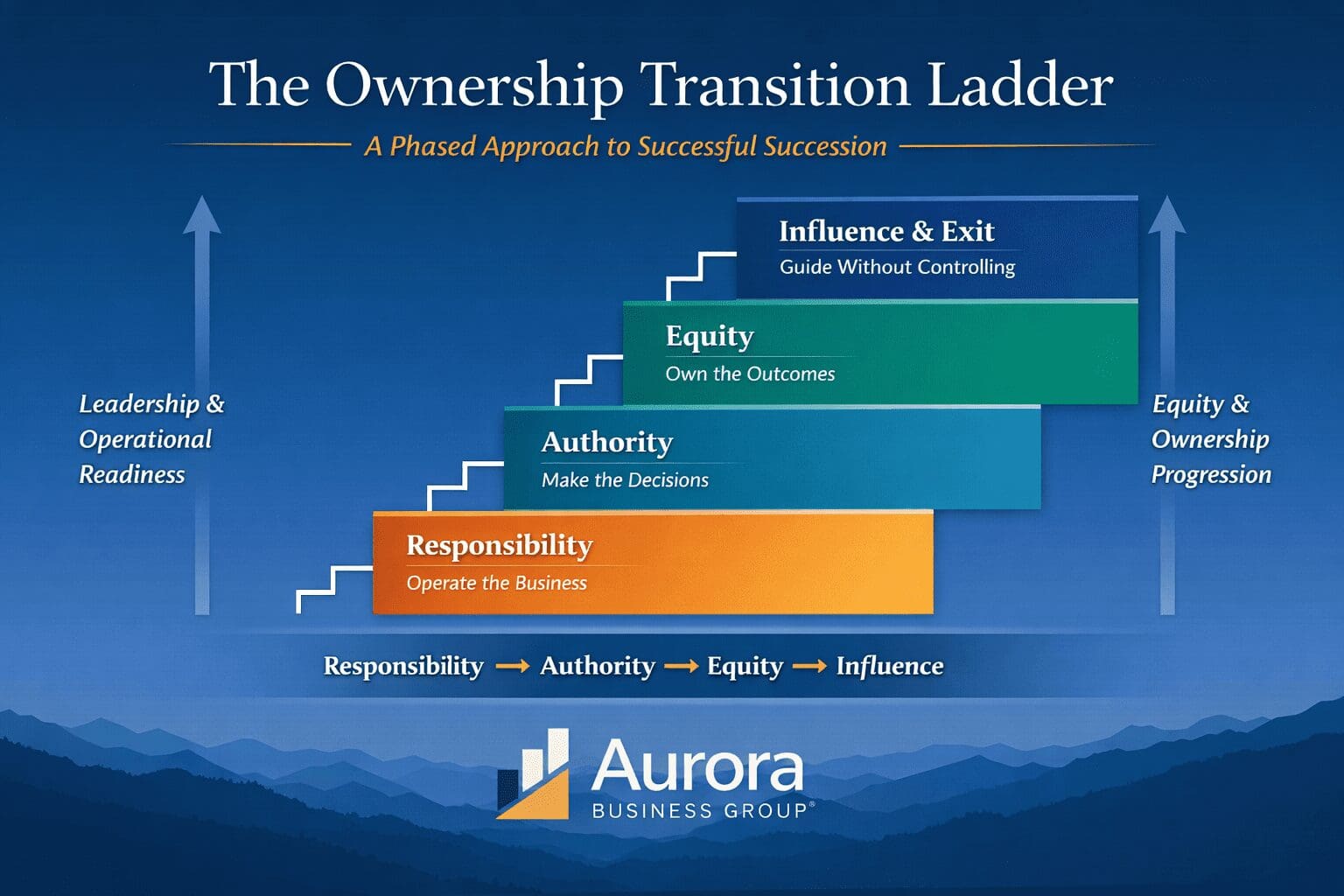
The Ownership Transition Ladder is a sequence—not a menu.
When companies compress it or skip rungs, failure is not accidental. It is designed into the system.

Below is what breakdown looks like when each shortcut is taken, the early warning signs that reveal it, and the corrective actions that prevent irreversible damage.

Shortcut 1

Skipping Responsibility → Premature Authority

When decision power is granted before leaders have carried full operational responsibility, authority collapses under pressure.

  • Decisions optimize departments instead of the enterprise
  • Problems are escalated upward rather than owned
  • Founders remain the default problem-solvers
  • Leaders succeed in silos but avoid cross-functional accountability
  • Operational issues return to the founder
  • Success is attributed to effort; failure to circumstances
  • Expand responsibility to enterprise-wide outcomes (P&L, cash flow, cross-team coordination)
  • Require leaders to own problems end-to-end before escalation
  • Establish clear metrics that reflect whole-company health, not departmental success

Goal: Prove operational maturity before granting authority.

Shortcut 2

Skipping Authority → Premature Equity

When equity is transferred before decision authority has been tested, ownership becomes emotional instead of strategic.

  • Equity holders feel financially exposed
  • Disagreements escalate quickly
  • Founders feel locked into premature commitments
  • New owners seek approval for major decisions
  • Founders override decisions “for protection”
  • Accountability blurs when outcomes disappoint
  • Formalize decision rights and escalation paths in writing
  • Allow leaders to make decisions and live with outcomes—good or bad
  • Delay equity transfer until authority is exercised confidently and consistently

Goal: Ensure decision confidence exists before capital is transferred.

Shortcut 3

Weak Equity Guardrails → Financial Stress

When ownership structures ignore cash flow reality, the business itself becomes the funding source.

  • Debt service competes with payroll and growth
  • Reinvestment is deferred
  • Leadership shifts from strategy to survival
  • Cash flow dominates leadership discussions
  • Owners disagree on distributions vs. reinvestment
  • Growth initiatives are postponed to “manage the deal”
  • Restructure buyout terms to align with conservative cash flow assumptions
  • Introduce payment deferrals, earn-outs, or performance-based schedules
  • Align ownership structures with lender covenants and operational realities

Goal: Protect the business while transferring ownership.

Shortcut 4

Skipping Emotional Readiness → Founder Re-Intervention

Legal exit without emotional readiness destabilizes leadership and culture.

  • Advice becomes direction
  • Coaching becomes correction
  • Authority quietly recenters around the founder
  • Founders attend operational meetings “just to listen”
  • Leaders hesitate before acting
  • Employees are unclear who is really in charge
  • Define founder role boundaries explicitly (advisor, board member, or mentor)
  • Establish structured check-ins instead of informal interventions
  • Provide founders with a purposeful post-transition role outside daily operations

Goal: Replace control with influence—intentionally.

Shortcut 5

Compressing the Phases → Organizational Paralysis

When responsibility, authority, equity, and exit are transferred simultaneously, pressure reveals every weakness.

  • Leaders feel overwhelmed
  • Accountability diffuses
  • Trust erodes under stress
  • Decisions stall or are repeatedly revisited
  • Conflicts become personal
  • “We’ll figure it out as we go” becomes common language
  • Pause the transition and re-sequence responsibilities
  • Reinforce one rung at a time before advancing
  • Document governance, authority, and decision rules explicitly

Goal: Restore clarity, pace, and confidence.

Why These Corrections Work

Corrective actions do not reverse progress—they stabilize it.

They:

  • Align leadership readiness with financial reality
  • Prevent resentment and regret
  • Preserve business momentum

Most importantly, they give founders and future owners permission to slow down without failing.

Final Reflection

Ownership transitions fail when speed is prioritized over sequence.

They succeed when maturity, trust, and clarity are earned—one rung at a time.

The ladder does not delay success.
It prevents collapse.