
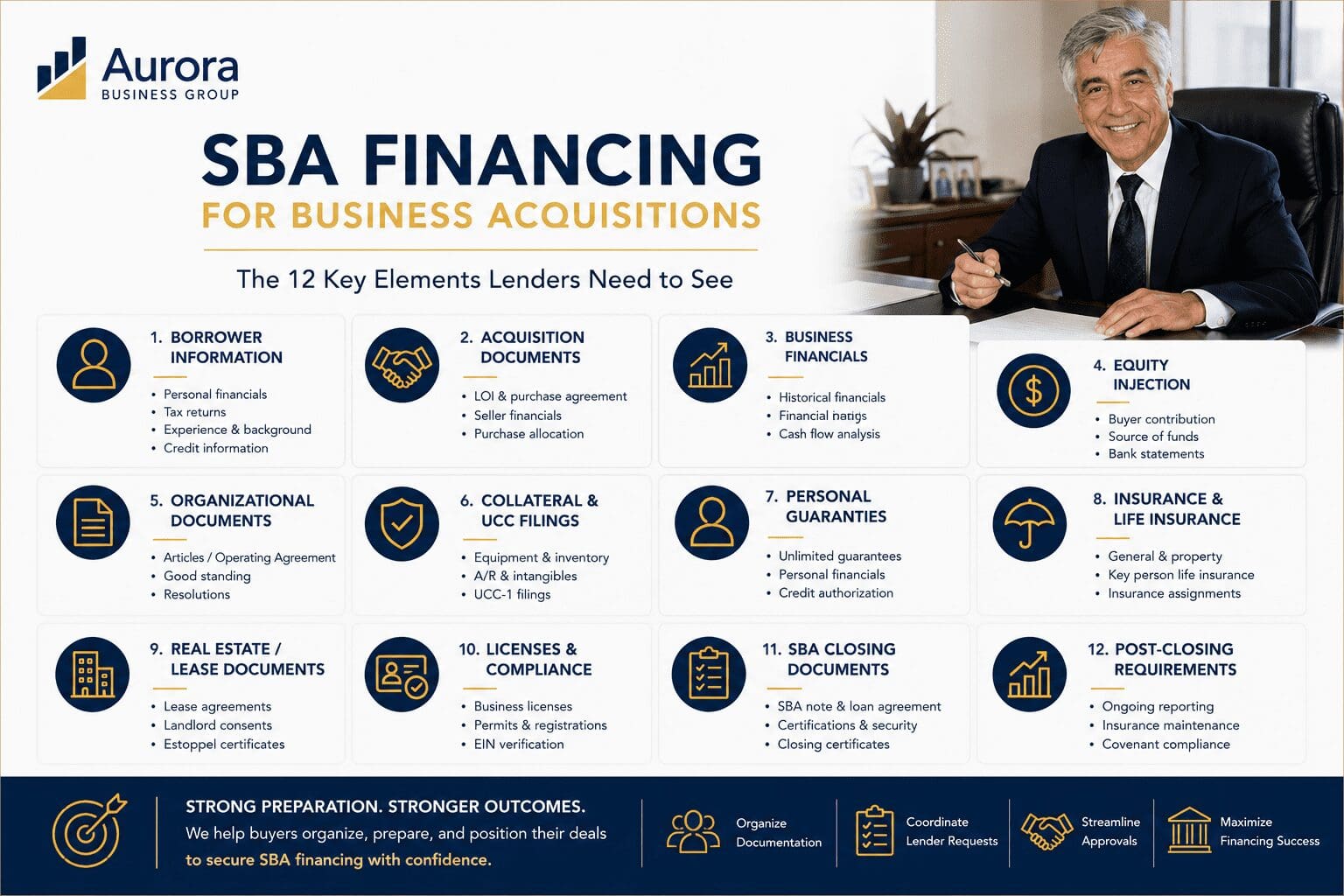
SBA Business Acquisition Financing Requirements
Purchasing an existing business often requires financing through the U.S. Small Business Administration (SBA) 7(a) Loan Program. While every transaction is unique, lenders generally require comprehensive documentation to evaluate the borrower, verify the business being acquired, and satisfy SBA underwriting requirements.
The following checklist summarizes the primary documents and information typically required when seeking SBA financing for a business acquisition.
1. Borrower Information
Personal Financial Information
- Personal Financial Statement (SBA Form 413)
- Personal tax returns (typically last 3 years)
- Resume or business experience summary
- Government-issued identification
- Personal bank statements
- Schedule of personal debts and obligations
Business Ownership Information
- Ownership structure and percentage ownership
- Organizational chart
- Current business affiliations
- Background disclosures
- SBA borrower information forms
2. Business Acquisition Documents
Purchase Transaction Documents
- Letter of Intent (LOI)
- Stock Purchase Agreement or Asset Purchase Agreement
- Purchase Price Allocation
- Seller financial disclosures
- Transition or consulting agreements (if applicable)
Business Valuation
- Independent business valuation (when required)
- Broker valuation package
- Supporting market analysis
3. Business Financial Documentation
Historical Financial Statements
- Last 3 years of business tax returns
- Profit & Loss Statements
- Balance Sheets
- Cash Flow Statements
- Interim financial statements
Financial Projections
- 12–36 month projections
- Debt service coverage analysis
- Assumptions supporting projected revenue and expenses
Working Capital Analysis
- Sources and Uses of Funds
- Operating capital requirements
- Post-closing liquidity plan
4. Equity Injection Requirements
Most SBA acquisition loans require the buyer to contribute a portion of the purchase price as equity.
Documentation May Include
- Bank statements showing available funds
- Wire confirmations
- Cancelled checks
- Closing settlement statements
- Gift letters (if applicable)
- Documentation proving source of funds
Lenders must verify that the required equity injection has been deposited and used for the transaction prior to loan disbursement. In the Aurora Energy acquisition, evidence of a $50,600 equity injection was required before funding.
5. Corporate and Organizational Documents
Depending on the entity type, lenders commonly require:
Corporation
- Articles of Incorporation
- Bylaws
- Certificate of Good Standing
- Corporate Resolution Authorizing Borrowing
LLC
- Articles of Organization
- Operating Agreement
- Certificate of Status
- Member Resolution Authorizing Borrowing
Partnership
- Partnership Agreement
- Partner Authorization Documents
- Good Standing Certificate
These organizational documents verify authority to borrow and execute loan documents.
6. Collateral Documentation
SBA lenders typically require a security interest in available business assets.
Business Asset Documentation
- Equipment lists
- Vehicle schedules
- Inventory reports
- Accounts receivable aging reports
- Asset schedules
UCC Filings
- UCC-1 Financing Statements
- UCC searches verifying lien positions
Typical collateral includes:
- Equipment
- Inventory
- Accounts Receivable
- General Intangibles
- Business Assets
- Contract Rights
Collateral requirements vary based on loan structure and available assets.
7. Personal Guaranties
Owners with significant ownership interests are generally required to provide personal guaranties.
Common Requirements
- Unlimited Personal Guaranty
- Personal Financial Statement
- Credit Authorization
- Spousal documentation when required
Lenders evaluate both business cash flow and the financial strength of guarantors.
8. Insurance Requirements
Lenders commonly require proof of insurance covering collateral and business operations.
Typical Insurance Requirements
- General Liability Insurance
- Property Insurance
- Hazard Insurance
- Workers Compensation (if applicable)
- Key Person Life Insurance (when required)
For some transactions, the lender may require assignment of a life insurance policy to secure repayment of the loan. In the Aurora Energy acquisition, life insurance collateral in the amount of $455,400 was required.
9. Real Estate and Lease Documentation
If the business operates from leased premises:
Required Lease Information
- Current Lease Agreement
- Amendments and Renewals
- Landlord Consent (when required)
- Subordination Agreements
- Estoppel Certificates (if requested)
The lease term must generally extend through the SBA loan term or include renewal options sufficient to satisfy SBA requirements.
10. Business Licenses and Regulatory Compliance
Borrowers must demonstrate legal authority to operate.
Examples
- State business licenses
- Professional licenses
- Contractor licenses
- Industry-specific permits
- Employer Identification Number (EIN)
Lenders typically verify that all licenses and permits are active and current before closing.
11. SBA Certifications and Closing Documents
At closing, borrowers are generally required to execute multiple SBA-specific documents, including:
Typical SBA Closing Package
- SBA Note (Form 147)
- SBA Loan Agreement
- SBA Borrower Certification
- Security Agreement
- Personal Guaranties
- Settlement Statement
- Equity Injection Certification
- UCC Filings
- Insurance Assignments
These documents establish the legal obligations of the borrower and guarantors and satisfy SBA lending requirements.
12. What Lenders Evaluate
Before approving an SBA loan, lenders generally review:
Borrower Factors
- Credit history
- Industry experience
- Management capability
- Personal financial strength
Business Factors
- Historical profitability
- Cash flow coverage
- Customer concentration
- Industry outlook
- Debt service capacity
Transaction Factors
- Purchase price justification
- Seller transition support
- Equity contribution
- Collateral coverage
- Post-closing working capital
How We Help
Our team works with buyers, sellers, and lenders throughout the acquisition process to prepare financing packages, organize due diligence materials, coordinate lender requests, and streamline SBA loan approvals.
Whether you are purchasing a renewable energy company, electrical contractor, solar installation business, service company, or other privately held business, we can help prepare the documentation needed to maximize lender confidence and improve financing outcomes.
Contact us to discuss your acquisition financing needs and receive a customized SBA loan preparation checklist.