
Why Ownership Transfers Fail: A Founder’s View from the Inside

After more than three decades building Aurora Energy, I learned a truth that surprises many founders:

Ownership transition is more complex—and more fragile—than building the business itself.

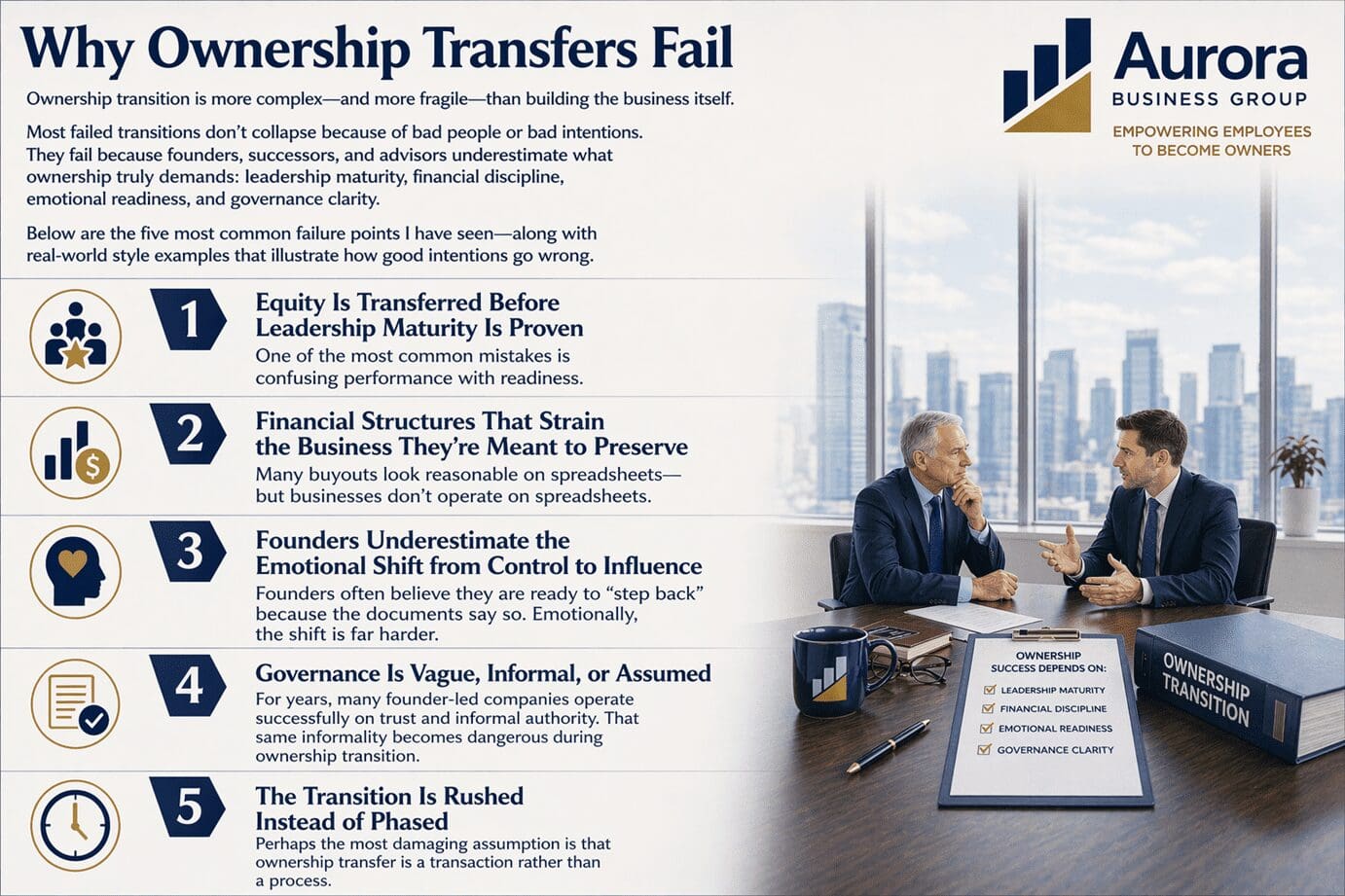
Most failed transitions don’t collapse because of bad people or bad intentions. They fail because founders, successors, and advisors underestimate what ownership truly demands: leadership maturity, financial discipline, emotional readiness, and governance clarity.

Below are the five most common failure points I have seen—along with real-world style examples that illustrate how good intentions go wrong.

Equity Is Transferred Before Leadership Maturity Is Proven

One of the most common mistakes is confusing performance with readiness.

A high-performing operations manager is offered a significant equity stake as recognition for years of dedication. Technically excellent, deeply loyal—but untested in enterprise-level decision-making.

Once ownership begins:

  • Decisions become reactive under pressure
  • Conflict is handled emotionally rather than strategically
  • The individual struggles to think beyond their functional silo

The founder becomes anxious. The new owner becomes defensive. Trust erodes.

The Lesson

Ownership is not a reward—it is a role.

Leadership maturity must be demonstrated under stress, not assumed based on tenure or skill.

Financial Structures That Strain the Business They’re Meant to Preserve

Many buyouts look reasonable on spreadsheets—but businesses don’t operate on spreadsheets.

A management buyout is structured with aggressive seller notes and optimistic profit assumptions. Early years appear manageable.

Then reality intervenes:

  • A delayed receivable cycle
  • A soft market year
  • Unexpected capital needs

Debt service begins competing with payroll and growth. Leadership starts making short-term decisions to survive long-term obligations.

The Lesson

A buyout that weakens cash flow weakens leadership.

If financing violates lender expectations or business reality, the transition becomes a slow internal crisis.

Founders Underestimate the Emotional Shift from Control to Influence

This is the least discussed—and most powerful—failure point.
Founders often believe they are ready to “step back” because the documents say so. Emotionally, the shift is far harder.

A founder retains a minority stake and advisory role. New leaders begin making decisions—some imperfect, some simply different.

The founder:

  • Offers “suggestions” that feel like directives
  • Steps in during moments of discomfort
  • Corrects publicly instead of coaching privately

The new owners begin to hesitate. Authority blurs. Confidence drops.

The Lesson

Letting go is not a legal event—it is an identity transition.

Without intentional emotional preparation, founders unintentionally reclaim control and stall ownership growth.

Governance Is Vague, Informal, or Assumed

For years, many founder-led companies operate successfully on trust and informal authority. That same informality becomes dangerous during ownership transition.

Multiple new shareholders assume they have equal say—but decision rights were never explicitly defined.

Questions arise:

  • Who decides compensation?
  • Who approves capital expenditures?
  • What happens when owners disagree?

Meetings become longer. Decisions slow. Conflict becomes personal.

The Lesson

Governance is not bureaucracy—it is protection.

Clear roles, voting rights, escalation paths, and boundaries are essential before conflict arises, not after.

The Transition Is Rushed Instead of Phased

Perhaps the most damaging assumption is that ownership transfer is a transaction rather than a process.

A founder announces a full ownership transition within a short timeframe. Responsibility, authority, and equity are transferred almost simultaneously.

When pressure hits:

  • New owners feel overwhelmed
  • Founders feel compelled to step back in

Everyone feels trapped by commitments made too quickly

The Lesson

Successful transitions follow a sequence:

  1. Responsibility before authority
  2. Authority before equity
  3. Equity before full exit

Skipping steps does not accelerate success—it accelerates stress.

The Predictable Outcome When These Issues Are Ignored

Across industries and company sizes, the results repeat:

  • Founders experience regret and loss of purpose
  • New owners feel resentment or inadequacy
  • Businesses lose momentum, culture, or financial strength

None of this is caused by bad intentions.
It happens because ownership transitions are rarely designed—they are improvised.
Why I Share This

Preparing Aurora Energy for its next chapter forced me to confront these realities honestly. It required slowing down, redesigning assumptions, and treating ownership transfer as a multi-year leadership journey—not a closing date.

That experience reshaped how I think about succession, governance, and legacy.

A well-designed ownership transition does more than preserve a business.
It protects people, culture, and the future—while allowing founders to step forward into influence instead of disappearing into absence.

A Question for Founders and Future Owners

If you’ve been through an ownership transition—
what challenged you more: letting go, or stepping up?