
Management Buyouts (MBO): A Structured Path to Ownership
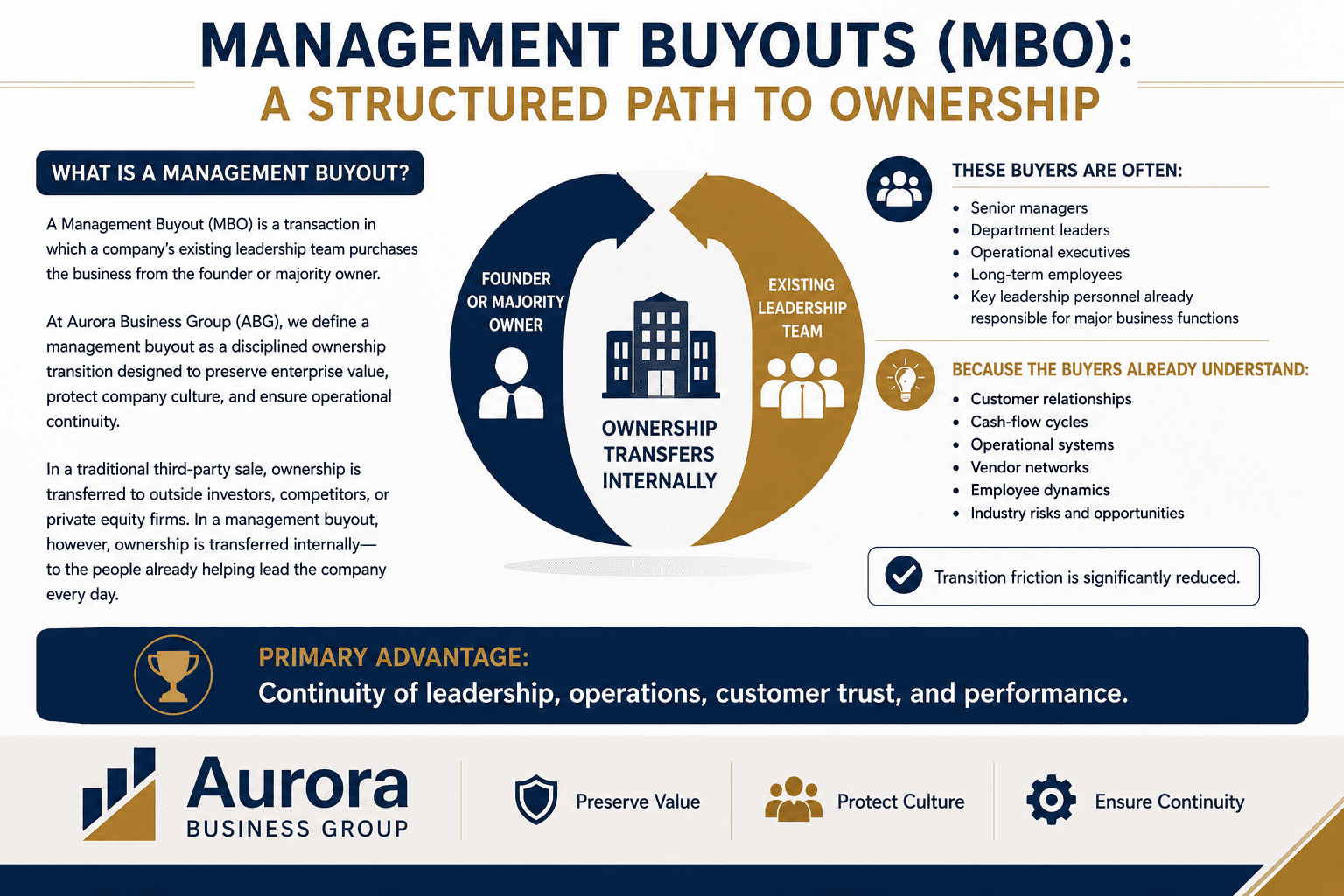
A Management Buyout (MBO) is a transaction in which a company’s existing leadership team purchases the business from the founder or majority owner. At Aurora Business Group (ABG), we define a management buyout as a disciplined ownership transition designed to preserve enterprise value, protect company culture, and ensure operational continuity.
In a traditional third-party sale, ownership is transferred to outside investors, competitors, or private equity firms. In a management buyout, however, ownership is transferred internally—to the people already helping lead the company every day.
These buyers are often:
- Senior managers
- Department leaders
- Operational executives
- Long-term employees
- Key leadership personnel already responsible for major business functions
Because the buyers already understand:
- Customer relationships
- Cash-flow cycles
- Operational systems
- Vendor networks
- Employee dynamics
- Industry risks and opportunities
transition friction is significantly reduced.
Primary Advantage:
Continuity of leadership, operations, customer trust, and performance.
Why Management Buyouts Are Increasing
Across the United States, many founder-led businesses are approaching generational transition.
Founders who spent decades building successful companies eventually face difficult questions:
- Who should own the business next?
- How can the founder preserve legacy and culture?
- How can employees and customers remain protected?
- How can ownership transfer occur without destabilizing operations?
- How can liquidity be achieved without harming the company?
For many founders, a management buyout offers a practical and emotionally aligned solution.
Rather than selling to an outside buyer focused primarily on financial return, founders may choose to transition ownership to the people already invested in the company’s long-term success.
Why Founders Often Prefer Internal Buyers
An outside buyer may understand valuation.
But an internal management team understands the business itself.
Internal buyers already know:
- Which customers are most critical
- Which operational systems are fragile
- Which employees are essential
- Which projects drive profitability
- Which risks threaten continuity
This institutional knowledge creates stability during transition.
In many cases, founders choose management buyouts because they want:
- The business to continue operating independently
- Employees to remain protected
- Customer relationships to remain stable
- Company culture to survive beyond the founder
- Leadership continuity after the transaction closes
For founders who care deeply about stewardship, this matters tremendously.
How a Management Buyout Works
A management buyout typically includes several coordinated components:
- Leadership Preparation
Future owners must demonstrate leadership maturity before ownership transfer.
This includes:
- Decision-making capability
- Financial discipline
- Operational coordination
- Governance readiness
- Strategic thinking under pressure
- Business Valuation
The company is valued using methods appropriate for:
- Cash flow
- Industry conditions
- Risk profile
- Debt capacity
- Market comparables
- Financing Structure
MBOs are commonly financed through combinations of:
- SBA 7(a) loans
- Local or regional bank financing
- Seller financing (seller notes)
- Investor participation
- HoldCo ownership structures
- Minority equity arrangements
- Governance Design
Ownership transition requires clear governance structures:
- Decision rights
- Voting authority
- Equity protections
- Compensation structures
- Buy-sell provisions
- Dispute resolution procedures
- Transition Oversight
The healthiest transitions occur gradually—not suddenly.
Founders often remain involved during a transition period to:
- Coach successors
- Support lender confidence
- Protect customer relationships
- Ensure operational continuity
What Makes a Management Buyout Different from a Traditional Sale?
The primary difference is continuity.
In a traditional acquisition:
- Leadership often changes
- Operations may be restructured
- Culture may shift quickly
- Employees may feel uncertain
In a management buyout:
- Existing leadership remains in place
- Customer relationships stay stable
- Institutional knowledge remains intact
- Operational disruption is reduced
The company continues operating with people already familiar with the business.
The Most Common Misunderstanding About MBOs
Many people assume that a management buyout is primarily a financial transaction.
In reality, it is a leadership transition.
Ownership changes behavior.
Managers who performed successfully inside departments must now think:
- Enterprise-wide instead of functionally
- Long-term instead of short-term
- Strategically instead of operationally
The transition from employee to owner requires:
- Financial accountability
- Risk management
- Leadership maturity
- Governance discipline
- Emotional resilience
This is why many ownership transitions fail when preparation is rushed.
Why Some Management Buyouts Fail
Most failed MBOs do not fail because of bad intentions.
They fail because:
- Equity is transferred before leadership maturity is proven
- Financing structures strain cash flow
- Governance is unclear or informal
- Founders are emotionally unprepared to release control
- Future owners underestimate ownership responsibility
- Operational systems remain dependent on the founder
The greatest mistake is treating ownership transfer as an event rather than a preparation process.
What Makes a Successful Management Buyout?
Successful management buyouts usually follow a phased sequence:
- Responsibility before authority
- Authority before equity
- Equity before full founder withdrawal
This allows future owners to demonstrate readiness under real operating conditions before carrying full ownership responsibility.
At ABG, we often describe this as:
“Preparation before valuation. Readiness before equity.”
The Role of SBA Financing in Management Buyouts
Many MBOs use SBA-backed financing because it allows internal buyers to acquire businesses without requiring large amounts of personal capital upfront.
SBA lenders typically evaluate:
- Cash-flow strength
- Debt-service coverage
- Leadership continuity
- Financial reporting quality
- Operational stability
- Governance structure
This is why lender-ready preparation is critical.
A strong management buyout is not simply financeable—it is operationally credible.
How Aurora Business Group (ABG) Helps
Aurora Business Group helps founders and management teams prepare for ownership before ownership changes hands.
We focus on:
- Founder readiness
- Leadership coaching
- Governance structure
- SBA and bank preparation
- Transition sequencing
- Financial discipline
- Operational continuity
- Ownership transition planning
ABG does not replace your attorney, CPA, or lender.
We prepare the transition so your professional advisors can work from a stronger, more organized foundation.
Final Reflection
A successful management buyout is not simply about transferring shares.
It is about transferring stewardship responsibly.
When structured thoughtfully:
- Founders preserve legacy
- Employees gain opportunity
- Lenders gain confidence
- Customers experience continuity
- Businesses remain stable beyond the founder
That is the true purpose of a well-designed management buyout.
Aurora Business Group (ABG)
Empowering Employees to Become Owners.
Helping Founders Transition with Confidence.