
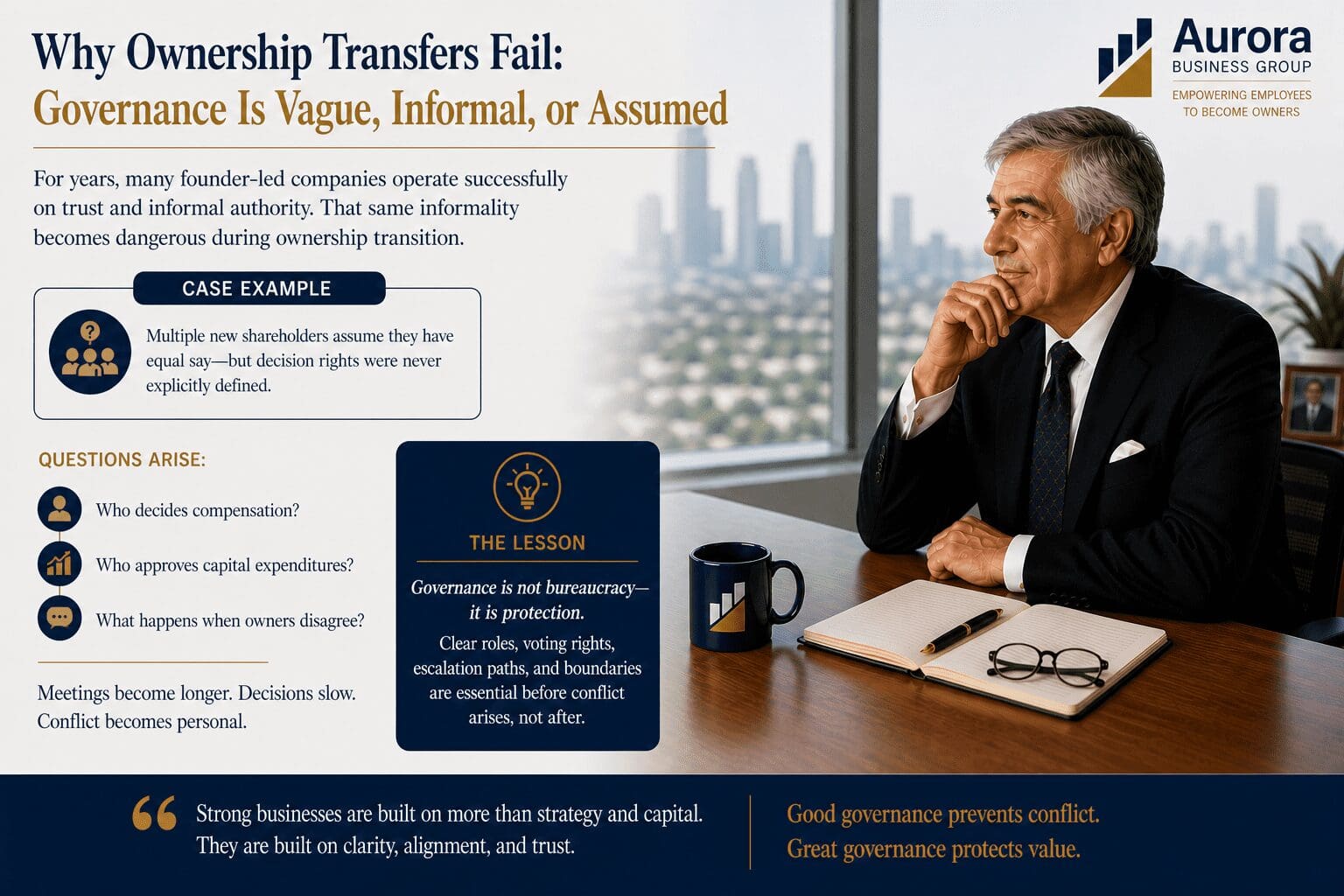
Governance Is Vague, Informal, or Assumed
For years, many founder-led companies operate successfully on trust and informal authority. That same informality becomes dangerous during ownership transition.
Case Example
Multiple new shareholders assume they have equal say—but decision rights were never explicitly defined.
Questions arise:
- Who decides compensation?
- Who approves capital expenditures?
- What happens when owners disagree?
Meetings become longer. Decisions slow. Conflict becomes personal.
The Lesson
Governance is not bureaucracy—it is protection.
Clear roles, voting rights, escalation paths, and boundaries are essential before conflict arises, not after.
Final Thought
Ownership transitions are among the most important decisions a founder will ever make.
They should not be left to chance—or compressed into a single transaction.
They should be designed with intention, executed with discipline, and aligned with the future of the business.
That is how companies move from founder-led to owner-driven—without losing what made them valuable in the first place.