
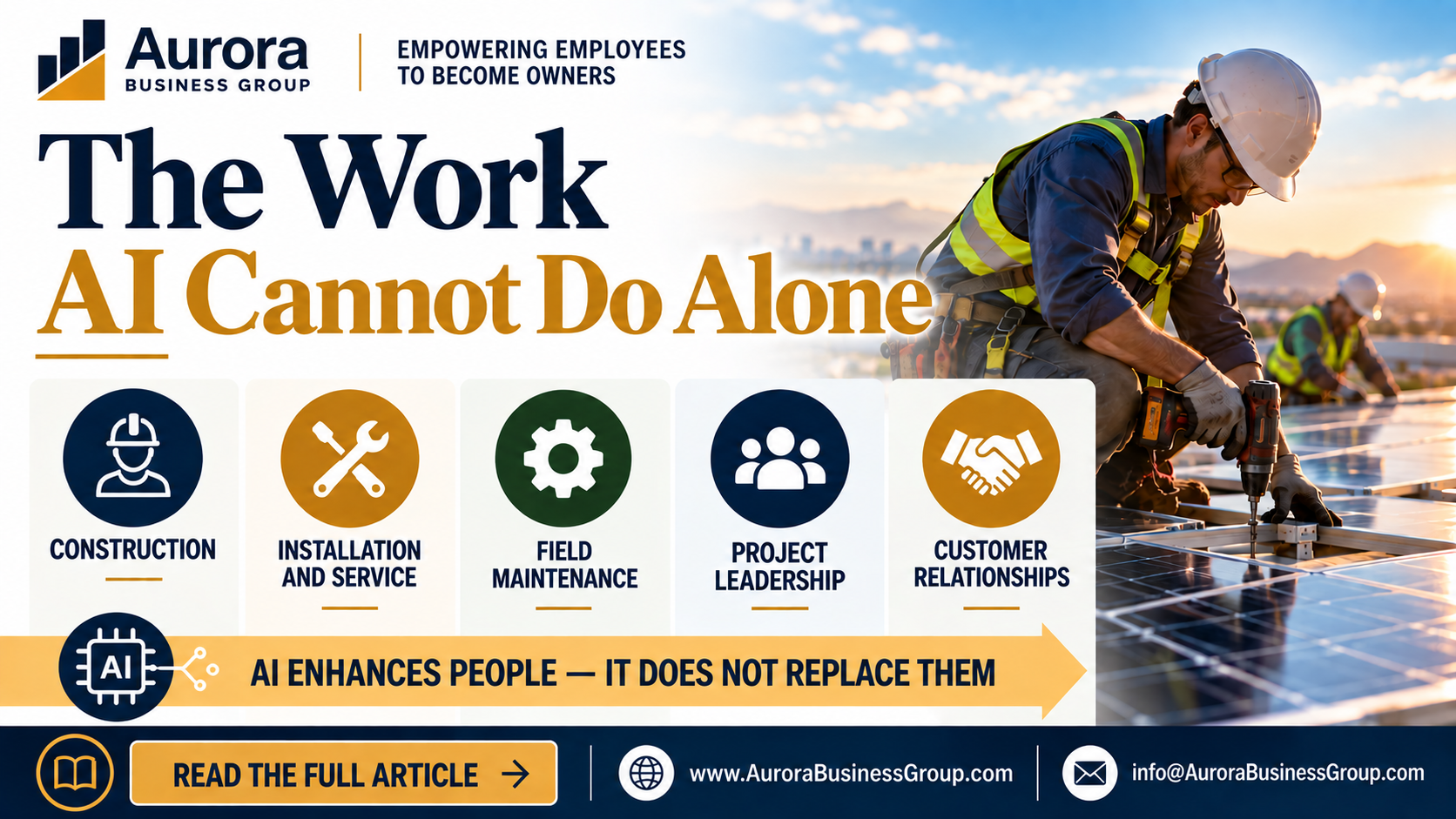
Why Physical Skills, Human Judgment, and Accountability Will Become More Valuable in the AI Economy
Much of today’s discussion about artificial intelligence begins with the same question:
How many jobs will AI replace?
That is an important question, but it can also lead business owners in the wrong direction.
AI will undoubtedly automate a growing amount of administrative and knowledge work. Scheduling, routine bookkeeping, document preparation, reporting, marketing support, data entry, and many other office functions will increasingly be performed or substantially assisted by AI agents.
But there is another side of the transformation that deserves equal attention.
There is an enormous category of work where something must physically happen in the real world—and someone must ultimately be responsible for making sure it happens correctly.
A solar array still has to be installed.
A building still has to be constructed.
An inverter still has to be replaced.
An electrical system still has to be commissioned.
A leaking roof still has to be repaired.
A customer experiencing a serious problem still wants to speak with someone who understands the situation and accepts responsibility for resolving it.
AI can assist with all of these activities.
But assistance is different from execution.
And that distinction should become an important part of how founders and new owners prepare their companies for the AI economy.
The Physical Economy Is Not Disappearing
We sometimes discuss AI as though the entire economy were becoming digital.
It is not.
Buildings, factories, solar installations, electrical systems, HVAC equipment, roads, vehicles, manufacturing equipment, data centers, warehouses, and millions of other physical assets still have to be built, operated, inspected, repaired, and eventually replaced.
Every digital system ultimately depends on a physical infrastructure.
Even AI itself requires enormous physical infrastructure: buildings, power systems, cooling, electrical distribution, communications networks, equipment, and continuing maintenance.
Someone has to design those systems.
Someone has to build them.
Someone has to inspect them.
Someone has to maintain them.
And when something fails at 2:00 in the morning, someone has to solve the problem.
This means that as AI becomes more capable, we should not automatically assume that human work becomes less valuable.
In many industries, certain forms of human work may become more valuable.
Consider a Solar Company
Solar provides an excellent example because it combines engineering, construction, technology, finance, customer relationships, and long-term maintenance.
AI can already help a solar company perform many activities more efficiently.
It can analyze utility bills.
It can review historical energy consumption.
It can assist with preliminary system sizing.
It can examine drawings.
It can help prepare proposals.
It can analyze project schedules.
It can organize field reports.
It can identify unusual system-performance patterns.
It can help prepare invoices and customer communications.
But eventually someone must arrive at the site.
Someone must understand the actual roof conditions.
Someone must determine whether what appears on a drawing corresponds to what exists in the field.
Someone must install racking, modules, conduit, wiring, switchgear, inverters, and monitoring equipment.
Someone must coordinate subcontractors.
Someone must enforce safety requirements.
Someone must inspect workmanship.
Someone must commission the system.
And years later, someone may need to return to diagnose why the system is no longer performing as expected.
The digital intelligence surrounding the project may increase dramatically.
The physical responsibility does not disappear.
AI Will Change the Technician—Not Necessarily Eliminate the Technician
Consider a service technician responding to an underperforming solar system.
Traditionally, the technician may arrive at the site, gather information, inspect equipment, review alarms, make measurements, and gradually diagnose the problem.
In an AI-enabled company, much of that analysis could begin before the technician leaves the office.
AI could review:
historical production;
weather information;
monitoring-system data;
equipment specifications;
previous service records;
error codes;
warranty information; and
similar failures across other installations.
By the time the technician arrives, the system may already suggest several likely causes and the equipment or replacement components that may be required.
Does that eliminate the technician?
No.
It may make the technician far more productive.
Instead of spending four hours diagnosing a problem, perhaps the technician can solve it in two.
Instead of making two trips to the site, perhaps the problem can be resolved in one.
Instead of relying only on personal memory, the technician may have access to the accumulated knowledge of thousands of previous service events.
That is not simply automation.
It is human capability multiplied by technology.
The Same Principle Applies to Estimating
Estimating is another good example.
AI will become increasingly capable of reviewing drawings, identifying quantities, comparing historical projects, analyzing material costs, and preparing preliminary estimates.
Some people may therefore conclude that estimators will no longer be needed.
I think the reality will be more nuanced.
A good estimator does much more than count materials.
An experienced estimator understands:
constructability;
labor productivity;
site access;
weather;
customer requirements;
subcontractor capability;
project sequencing;
supply-chain risk;
unusual conditions;
competitive positioning; and
where previous projects have lost money.
AI may calculate what is shown on the drawings.
The experienced professional asks:
“What is missing from the drawings?”
That difference can determine whether a project earns money or loses money.
The future estimator may therefore spend less time performing calculations and more time evaluating risk, strategy, constructability, and judgment.
That can make the profession more valuable, not less.
Engineers Will Move From Production Toward Judgment
Engineering will undergo a similar transformation.
AI can accelerate calculations, compare design alternatives, identify conflicts, review technical information, and generate preliminary documentation.
Routine engineering production may require fewer human hours.
But engineering responsibility extends beyond producing drawings.
Someone must decide whether a design is appropriate.
Someone must understand unusual field conditions.
Someone must reconcile competing objectives involving safety, cost, schedule, performance, code requirements, and customer expectations.
And ultimately, someone must be accountable for the technical decision.
The engineer of the future may therefore spend less time producing routine documentation and more time exercising professional judgment.
Again, the question is not simply:
“Will AI replace engineers?”
The better question is:
“Which engineering tasks will AI perform so that engineers can concentrate on the decisions where their expertise matters most?”
Project Managers May Become More Important
Project management is another area where AI can create enormous productivity.
A project manager today may spend substantial time:
reading emails;
updating schedules;
preparing reports;
documenting meetings;
tracking open items;
reviewing change orders;
following up with subcontractors;
and communicating routine project information.
AI can increasingly assist with many of these tasks.
Imagine an AI system continuously reviewing project correspondence, schedule changes, procurement information, field reports, weather conditions, budget information, and subcontractor commitments.
It may warn the project manager:
“This equipment delivery is likely to delay electrical completion by six days.”
Or:
“Labor productivity on this project has been below estimate for three consecutive weeks.”
Or:
“Three unresolved change orders are creating $85,000 of unapproved exposure.”
The AI identifies the problem.
But who decides what to do?
Who calls the subcontractor?
Who negotiates with the customer?
Who decides whether to accelerate the schedule?
Who takes responsibility when the project is behind?
The project manager does.
AI may remove much of the administrative burden of project management while increasing the importance of leadership, negotiation, judgment, and accountability.
Customer Relationships Become More Important When Technology Becomes Common
There is another paradox that business owners should consider.
As AI becomes available to everyone, technology itself may become less of a differentiator.
Your competitor may have access to the same AI tools.
The customer may have them as well.
What becomes more valuable when everyone has sophisticated technology?
Trust.
Customers still want to know:
Who will answer when there is a problem?
Who understands my business?
Who will stand behind the work?
Who has the authority to make a decision?
Who will tell me the truth when the answer is difficult?
And who will take responsibility if something goes wrong?
This is particularly important for expensive, long-lived assets such as buildings, energy systems, industrial equipment, and infrastructure.
A customer may appreciate an AI-generated answer.
But when a $2 million project is delayed, the customer does not want only a chatbot.
The customer wants an accountable person.
Accountability May Become One of the Most Valuable Human Skills
This leads to a broader point.
AI can generate recommendations.
AI can analyze information.
AI can identify patterns.
AI can prepare documents.
AI can propose solutions.
But organizations still need people who are willing and authorized to say:
“I understand the situation. This is the decision. I am responsible for the outcome.”
That is leadership.
And I believe leadership and accountability will become increasingly valuable as organizations automate more routine work.
In other words, the human advantage will not simply be that people can perform physical work.
It will also be that people can own consequences.
The Workforce Strategy Should Therefore Change
If we accept that administrative work will increasingly be automated while physical execution, judgment, relationships, and accountability remain important, then workforce planning should change now.
Companies should gradually move talent toward the parts of the organization where human capability will remain most valuable.
For a construction, solar, engineering, or service company, that may include:
construction management;
field supervision;
service and maintenance;
commissioning;
project management;
estimating and preconstruction;
quality assurance;
customer relationships;
technical sales;
procurement strategy;
field engineering; and
leadership.
This does not mean taking an accountant tomorrow and sending that person onto a roof.
Retraining must be thoughtful.
Some transitions may take years.
Employees may need technical education, mentoring, certifications, field exposure, financial training, safety training, or progressively greater operational responsibility.
That is precisely why companies should begin before positions become obsolete.
Service and Maintenance Deserve Special Attention
I believe service and maintenance will become particularly important for companies with large installed bases.
Every system a company installs creates a potential long-term relationship.
Solar systems need monitoring.
Inverters fail.
Equipment ages.
Roofs require work.
Electrical components require inspection.
Technology becomes obsolete.
Customers expand facilities.
Systems require modernization.
A company that has spent twenty years installing projects may already possess an enormous future service market among its own customers.
AI can make that service organization substantially more efficient by predicting failures, analyzing system performance, prioritizing service calls, identifying parts requirements, and assisting technicians with diagnostics.
But the physical work still requires people.
For owners thinking strategically about AI, this creates an important possibility:
Use AI to reduce administrative labor while simultaneously expanding human capacity in service, maintenance, construction, and customer support.
That is a much more compelling strategy than simply reducing headcount.
This Is Particularly Important After a Management Buyout
New owners following a management buyout face a special challenge.
They have purchased a company based largely on its historical success.
But historical success can create a dangerous assumption:
If we continue doing what made the company successful, the company will remain successful.
That is not necessarily true.
The new owners must protect the company’s existing strengths while redesigning it for the environment that is coming.
They should ask:
Where will AI reduce administrative workload?
Where can we expand service and maintenance?
Which employees can move toward project management or field operations?
Which engineers can become stronger customer-facing technical leaders?
Which employees demonstrate the judgment and accountability required for greater responsibility?
Which positions should become AI-enhanced rather than eliminated?
And what should the organization look like five years from now?
That is ownership thinking.
Do Not Confuse Fewer Administrative Hours With Fewer Valuable People
This distinction may ultimately be the most important.
AI will almost certainly reduce the human hours required for many activities.
But fewer required hours do not automatically mean fewer valuable employees.
A company can choose to capture AI productivity in several ways.
It can reduce headcount.
It can increase profit.
It can lower prices.
It can grow without increasing overhead.
Or it can redeploy capable people into activities that strengthen the company.
The right answer will differ by business.
But leaders should make that decision strategically—not automatically.
Before eliminating a good employee, ask:
“Is the person’s value disappearing—or is only the old way we used that person’s time disappearing?”
Those are very different situations.
The Aurora Business Group Perspective
At Aurora Business Group, we believe preparing employees for ownership means preparing them for the company that will exist in the future—not simply the company that exists today.
AI should therefore become part of succession planning, management development, and ownership preparation.
Future owners must understand both sides of the equation.
They must know what to automate.
And they must know where to invest more deeply in people.
The strongest companies will combine artificial intelligence with human capability.
AI will process information.
People will exercise judgment.
AI will identify patterns.
People will make consequential decisions.
AI will improve planning.
People will build, install, repair, lead, negotiate, and maintain relationships.
AI will increase capability.
People will remain accountable.
For founders preparing successors and managers preparing to become owners, that distinction deserves to become part of the company’s long-term workforce strategy.
**Automate what technology does best.
Strengthen what people do best.
Build the company around both.**
That is how AI becomes an enterprise-value strategy rather than simply a labor-reduction strategy.
Aurora Business Group
Empowering Employees to Become Owners