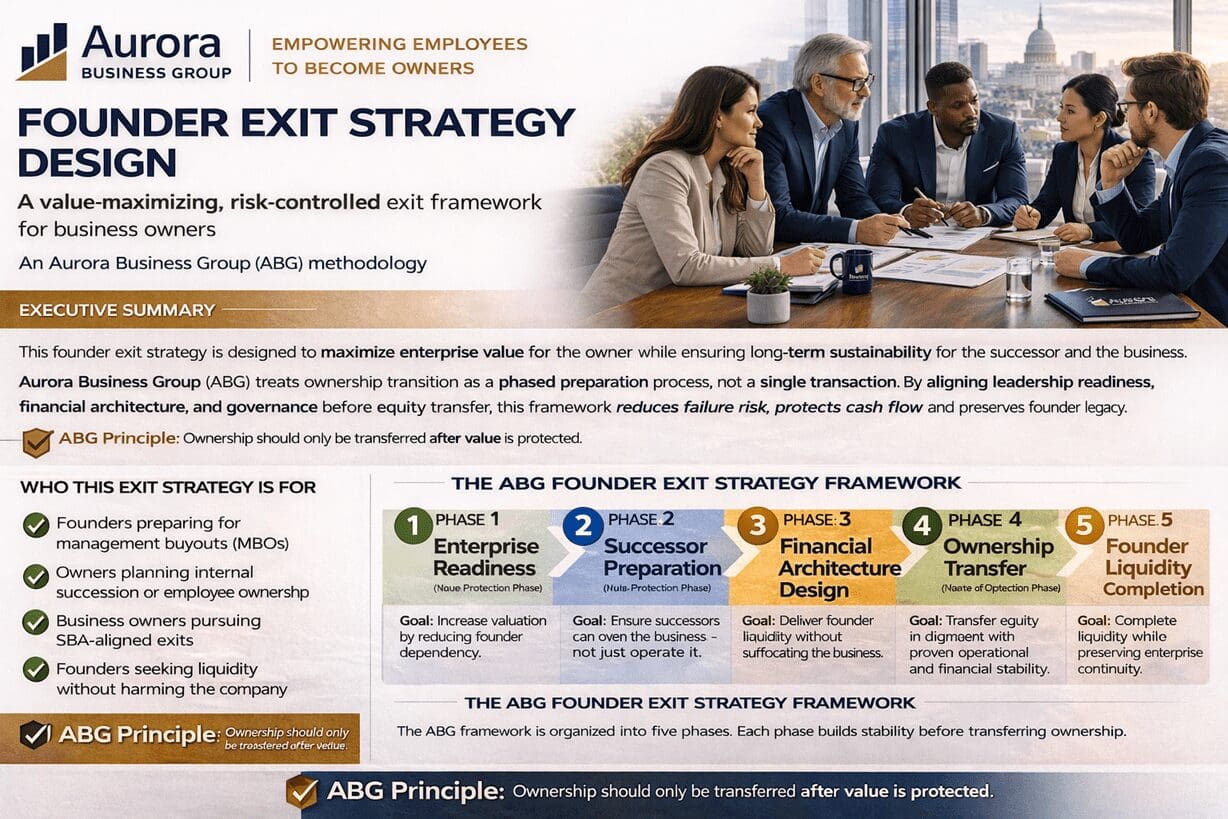

A value-maximizing, risk-controlled exit framework for business owners
An Aurora Business Group (ABG) methodology

Executive Summary

This founder exit strategy is designed to maximize enterprise value for the owner while ensuring long-term sustainability for the successor and the business.

Aurora Business Group (ABG) treats ownership transition as a phased preparation process, not a single transaction. By aligning leadership readiness, financial architecture, and governance before equity transfer, this framework reduces failure risk, protects cash flow, and preserves founder legacy.

ABG Principle:
Ownership should only be transferred after value is protected.

Who This Exit Strategy Is For

This framework is designed for:

  • Founders preparing for management buyouts (MBOs)
  • Owners planning internal succession or employee ownership
  • Business owners pursuing SBA-aligned exits
  • Founders seeking liquidity without harming the company

The Exit Philosophy

The exit planning model is built on five core principles:

  1. Preparation precedes monetization
  2. Risk transfers gradually — not abruptly
  3. Cash flow stability comes before equity transfer
  4. Leadership maturity must be demonstrated — not assumed
  5. Founder influence evolves into governance — not disappearance

The framework is organized into five phases.

  1. Enterprise Readiness
  2. Successor Preparation
  3. Financial Architecture Design
  4. Ownership Transfer
  5. Founder Liquidity Completion

Phase 3: Financial Architecture Design

(Value Extraction Phase)

Goal: Deliver founder liquidity without suffocating the business.

  • Phased management buyouts
  • SBA-backed internal acquisitions
  • Seller notes with protective covenants
  • Partial founder equity retention

Founder Benefits:

  • Predictable payouts
  • Downside protection
  • Optional exit timing

Company Benefits:

  • Preserved working capital
  • Sustainable debt levels
  • Continued growth capacity

Phase 1: Enterprise Readiness

(Value Protection Phase)

Goal: Increase valuation by reducing founder dependency.

    • Formalize decision authority and reporting structures
    • Document operational and financial processes
    • Strengthen second-tier leadership

Key Outcome:

Higher valuation multiples, lower key-person risk, and increased buyer and lender confidence.

Phase 4: Ownership Transfer

(Controlled Transition Phase)

Goal: Transfer equity in alignment with proven operational and financial stability.

  • Equity released in tranches
  • Voting control may lag economic ownership
  • Board governance established before full exit

Founder Role Evolution:
Operator → Chair, Advisor, or Board Member

ABG Insight:
Rapid, unstructured exits often lead to post-exit regret and business decline.

Phase 2: Successor Preparation

(Risk Reduction Phase)

Goal: Ensure successors can own the business — not just operate it.

  • Financial literacy (cash flow, debt service, covenants)
  • Leadership under stress and accountability
  • Governance discipline and decision-making

ABG Rule:
Equity is not transferred until leadership maturity is proven.

Risk Controls:

  • Phantom equity before real shares
  • Performance-based milestones
  • Independent financial oversight

Phase 5: Founder Liquidity Completion

(Legacy & Optional Exit Phase)

Goal: Complete liquidity while preserving enterprise continuity.

    • Final share redemption
    • Secondary internal sale
    • Long-term dividend participation
    • Strategic sale with successor leadership in place

Legacy Protection:
Cultural values codified, governance enforced, founder reputation preserved.

Built-In Risk Controls

Risk Area ABG Mitigation
Leadership failure Phased equity and performance milestones
Cash flow strain Conservative leverage and reserves
Lender conflict SBA-aligned financial structures
Founder regret Gradual control transition
Cultural erosion Governance before full exit

Benefits of the ABG Founder Exit Strategy

Benefits for Founders

  • Maximized valuation
  • Predictable liquidity
  • Retained optionality
  • Legacy protection

Benefits for the Business

  • Leadership continuity
  • Financial resilience
  • Stakeholder confidence
  • Long-term independence