
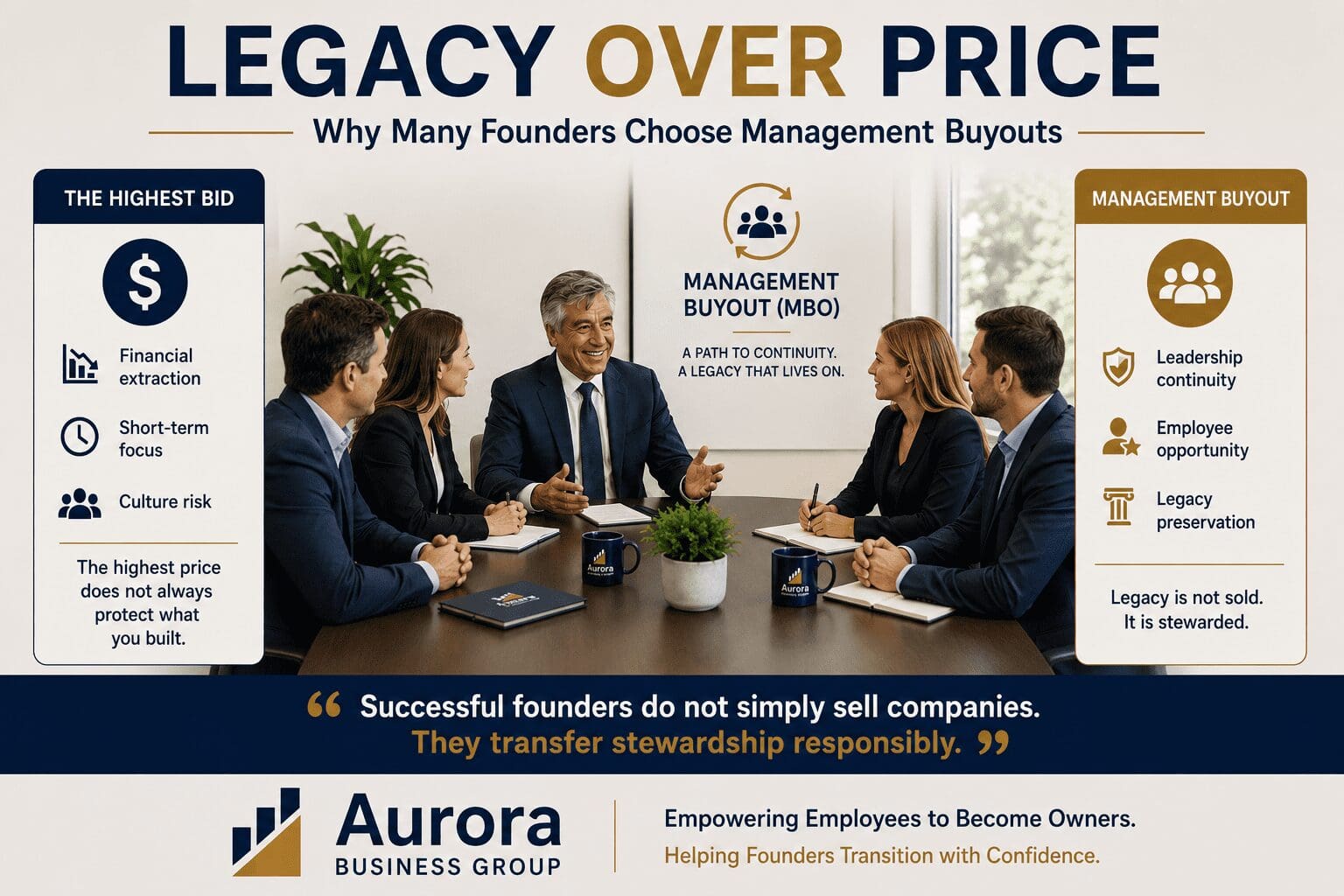
Why Many Founders Choose Management Buyouts Instead of the Highest Bid?
After decades of building a business, many founders eventually face one of the most important decisions of their lives:
Who should own the company next?
For outsiders, the answer often appears simple:
Sell to the highest bidder.
But for many founders, the decision is far more personal than financial.
A business is rarely just an asset on a balance sheet.
It represents:
- Years of sacrifice
- Employees who helped build the company
- Customer relationships earned through trust
- A culture developed over decades
- A reputation tied directly to the founder’s name
- A mission that shaped people’s careers and lives
That is why many founders ultimately prioritize legacy over maximizing the sale price.
The Misunderstood Reality of Business Ownership Transition
In the world of mergers and acquisitions, success is often measured by valuation.
But founders who have spent decades operating businesses understand something deeper:
The highest offer is not always the best outcome.
External buyers may offer larger purchase prices because they see:
- Market share opportunities
- Operational consolidation potential
- Financial restructuring advantages
- Cost-cutting opportunities
- Strategic integration value
Those goals are financially rational.
But they do not always preserve the business the founder spent a lifetime building.
Employees may lose stability.
Culture may disappear.
Customer relationships may weaken.
Long-term operational continuity may become secondary to short-term financial optimization.
For many founders, that outcome feels less like succession—and more like surrender.
Why Management Buyouts Become Attractive?
A Management Buyout (MBO) allows ownership to transition internally to the people already helping lead the company.
These are often:
- Senior managers
- Long-term operational leaders
- Department heads
- Key employees who understand the organization deeply
Unlike outside buyers, internal successors already understand:
- The customers
- The operational systems
- The company culture
- The risks and opportunities
- The employees behind the business
Most importantly, they understand why the business was built the way it was.
That continuity matters.
In many successful management buyouts, founders intentionally choose:
- Stability over disruption
- Stewardship over speculation
- Continuity over speed
- Long-term sustainability over maximum valuation
The founder may receive less money upfront than a private equity transaction might provide.
But the founder gains something many consider even more valuable:
confidence that the business will survive and continue responsibly after they step away.
Legacy Is Not Sentimental — It Is Strategic
Some people incorrectly assume that prioritizing legacy is purely emotional.
In reality, protecting legacy is often strategically intelligent.
Strong culture, customer trust, employee loyalty, and operational continuity are forms of enterprise value.
Destroying those elements may increase short-term financial extraction while weakening long-term business stability.
Founders who prioritize legacy often understand:
- Employees are not interchangeable
- Reputation takes decades to build
- Customer trust compounds slowly
- Leadership continuity protects cash flow
- Institutional knowledge cannot easily be replaced
A carefully designed ownership transition protects these assets.
The Transition Is About More Than Shares
One of the greatest misconceptions about management buyouts is believing they are simply stock transactions.
They are not.
A successful MBO requires:
- Leadership maturity
- Governance discipline
- Financial readiness
- Operational structure
- Emotional preparation from the founder
- Long-term alignment between future owners
The healthiest transitions happen gradually.
Responsibility develops before authority.
Authority develops before equity.
Equity develops before full founder withdrawal.
Without preparation, even well-intentioned transitions can create instability.
Founders Often Face an Emotional Decision
Many founders underestimate how emotional ownership transition becomes.
For decades, the founder may have:
- Solved every major crisis
- Carried payroll risk personally
- Protected employees during downturns
- Made sacrifices invisible to others
Letting go is not simply a legal event.
It is an identity transition.
That is why founders who choose management buyouts are often selecting more than a transaction structure.
They are choosing the future character of the company.
What Successful Founders Ultimately Want
In my experience, most founders eventually want three things:
- Financial security
- Protection of what they built
- Confidence that the business will continue successfully without them
A properly structured management buyout can align all three.
When done thoughtfully:
- Employees gain opportunity
- Future leaders gain ownership responsibility
- Customers experience continuity
- Lenders gain confidence
- Communities retain stable businesses
- Founders preserve both liquidity and legacy
That combination is powerful.
Final Reflection
The true value of a business is not measured only by the final purchase price.
It is also measured by:
- The people it continues to support
- The culture it preserves
- The opportunities it creates
- The reputation it protects
- The stability it provides after the founder exits
For many founders, that is the real definition of success.
Not simply selling the company.
But transferring stewardship responsibly.
Aurora Business Group (ABG)
Empowering Employees to Become Owners.
Helping Founders Transition with Confidence.