
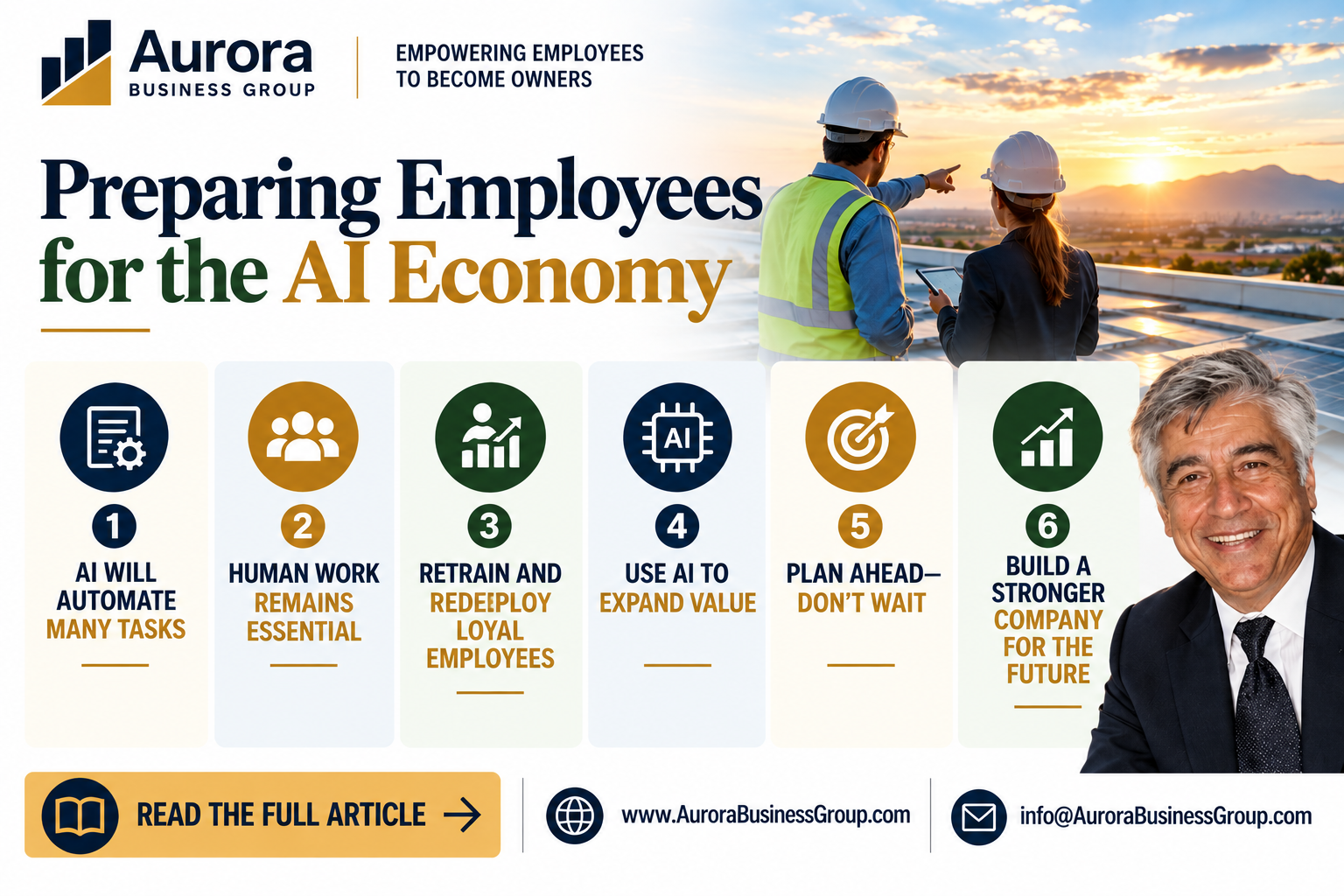
Why the Next Generation of Owners Must Redesign Work Before Eliminating Jobs
Artificial intelligence is no longer simply another software tool.
It is beginning to change the fundamental relationship between people, work, and the organizations that employ them.
For decades, businesses used technology primarily to make employees more productive. Computers replaced typewriters. Accounting software replaced handwritten ledgers. Email replaced much business correspondence. Enterprise software connected departments and standardized processes.
AI represents something different.
Increasingly, AI agents will not simply help an employee perform a task. They will be capable of performing significant portions of the task themselves—receiving information, analyzing it, making routine decisions, generating documents, communicating with other systems, and initiating the next step in a workflow.
For founders, CEOs, and particularly new owners emerging from a management buyout, this creates both an extraordinary opportunity and an important responsibility.
The easy response is to ask:
“Which employees can AI replace?”
I believe that is the wrong starting question.
A better question is:
“Which work will AI perform, which work will still require people, and how do we prepare our best employees today for the jobs the company will need tomorrow?”
That distinction matters enormously.
A company that waits until AI has already eliminated the economic justification for certain positions may eventually be forced to reduce its workforce.
A visionary company starts years earlier.
It redesigns the work.
It retrains capable people.
It moves employees toward activities where human capability continues to create value.
And it uses AI not simply to reduce payroll, but to build a stronger company.
Not Every Job Will Be Affected in the Same Way
One of the mistakes in discussing AI is treating every occupation as if it faces the same risk.
It does not.
The better unit of analysis is often the task, not the job title.
Consider the back office of a typical construction, solar, engineering, or service company.
Today, people may spend substantial time:
- preparing invoices;
- entering accounting information;
- reconciling transactions;
- scheduling maintenance;
- preparing routine customer communications;
- updating CRM records;
- producing standard reports;
- processing documents;
- coordinating calendars;
- preparing routine marketing material;
- following up on receivables;
- assembling management reports; and
- transferring information from one system to another.
These activities are necessary, but many are structured, repetitive, information-based, and governed by recognizable rules.
That makes them increasingly suitable for automation by AI agents.
The transition will not happen overnight, and human review will remain important—particularly for financial controls, unusual transactions, compliance, and consequential decisions.
But the direction is becoming increasingly clear.
A growing portion of administrative work will require fewer human hours.
That creates an uncomfortable question:
What happens to the people who perform that work today?
Physical Work and Human Accountability Will Remain Critical
Now consider a different category of work.
A solar contractor cannot ask an AI agent to climb onto a commercial roof and install a photovoltaic array.
An AI agent cannot physically replace an inverter, diagnose a damaged electrical connection in the field, repair roof penetration, install conduit, supervise a construction site, or safely commission an electrical system.
Construction still requires people.
Field maintenance still requires people.
Equipment installation still requires people.
Inspection and physical troubleshooting still require people.
Project leadership still requires accountable people.
And customers will continue to value trusted human relationships, particularly when a project is complicated, expensive, delayed, or experiencing a problem.
AI will certainly influence these activities.
An estimator may use AI to analyze drawings and develop preliminary quantities.
An engineer may use AI to accelerate design alternatives.
A project manager may use AI to identify schedule conflicts and summarize field reports.
A service technician may use AI to diagnose equipment before arriving at a site.
A salesperson may use AI to prepare a proposal before meeting a customer.
But in these examples, AI is not necessarily replacing the professional.
It is increasing the capability of the professional.
That distinction should become central to workforce planning.
From AI-Replaced Work to AI-Enhanced Work
I see three broad categories emerging.
- Work that can be substantially automated
This includes many repetitive administrative and information-processing activities.
Bookkeeping entry, routine invoicing, scheduling, document preparation, basic reporting, standard marketing production, CRM administration, and repetitive correspondence are examples.
These areas should be reviewed systematically for automation.
- Work that will be AI-enhanced
Engineering, estimating, project management, sales, customer service, financial management, procurement, and management decision-making fall increasingly into this category.
AI may perform substantial analytical work, but people continue to provide judgment, accountability, relationships, contextual understanding, and final decisions.
The employee who learns to use AI effectively may become dramatically more productive than the employee who does not.
- Work that remains fundamentally human and physical
Construction, installation, field service, maintenance, commissioning, physical inspection, equipment repair, and many forms of site supervision remain dependent upon people being physically present.
These jobs will also become more technology-enabled, but they are much more difficult to remove from the human workforce.
This framework gives management a much better basis for planning than simply asking which departments should be reduced.
Do Not Wait Until an Employee’s Job Disappears
This is where I believe business owners have an important responsibility.
Suppose you have an employee who has worked with the company for ten years.
The employee is intelligent, dependable, loyal, hardworking, understands the culture, knows the customers, and has repeatedly demonstrated initiative.
But much of that employee’s current administrative work can eventually be automated.
Should the company wait until AI can perform 80 percent of the employee’s responsibilities and then eliminate the position?
I do not believe that is good management.
The company already possesses something valuable:
a proven person.
Technology can be purchased.
Processes can be redesigned.
Skills can be taught.
But finding people with judgment, commitment, integrity, institutional knowledge, and genuine loyalty to an organization is much more difficult.
A forward-looking CEO should therefore begin asking:
“Where will this person’s capabilities create greater value three years from now?”
That employee might become a project coordinator.
A project coordinator might become an assistant project manager.
An assistant project manager might become a project manager.
A technically inclined administrative employee might move toward estimating, procurement, quality assurance, system monitoring, or service operations.
An engineer whose repetitive design work becomes automated might spend more time in field engineering, project leadership, customer consultation, commissioning, or technical business development.
The objective is not to preserve every existing position forever.
It is to preserve and redeploy human capability whenever doing so makes economic and organizational sense.
Expand the Human Side of the Business Before You Shrink the Workforce
This creates an interesting strategic opportunity.
If AI makes the back office more efficient, the company may not need as many people performing traditional administrative work.
But that does not automatically mean the company needs fewer people overall.
Management can use the productivity created by AI to expand areas that generate revenue and strengthen customer relationships.
For a solar or construction company, this might mean expanding:
Service and maintenance.
Every installed system eventually requires inspection, troubleshooting, repair, replacement components, monitoring, or modernization.
Construction capacity.
A stronger field organization can allow the company to perform more work internally rather than relying excessively on subcontractors.
Project management.
Better project managers can improve margins, schedules, quality, communication, and customer satisfaction.
Estimating and preconstruction.
AI can accelerate estimating, but knowledgeable people remain essential for understanding constructability, risk, labor conditions, field realities, and customer expectations.
Customer relationships.
As routine communications become automated, meaningful human interaction may actually become more valuable.
Quality assurance and commissioning.
These activities protect both the customer and the company’s reputation.
The organization therefore becomes more productive without necessarily becoming less human.
It becomes human in different places.
The COVID Experience Already Taught Us Something
The pandemic gave businesses an unexpected lesson about the nature of work.
Before COVID-19, many companies assumed that employees needed to be physically present in an office to perform effectively.
Then circumstances forced organizations to reconsider that assumption almost overnight.
Businesses discovered that many activities could be performed remotely.
The lesson was not simply that people could work from home.
The deeper lesson was:
Where work is performed can change much faster than organizations expect when technology and necessity converge.
AI may create another transition of similar magnitude.
This time, the question will not merely be where the work is performed.
It will be:
Who—or what—performs each part of the work?
Companies that begin answering that question now will have much more control over the transition.
The Special Responsibility of New Owners After an MBO
This issue is particularly important in a management buyout.
When managers purchase the company from its founder, their immediate instinct is often continuity.
Keep the customers.
Keep the employees.
Keep revenue flowing.
Service the acquisition debt.
Do not disturb a business model that has already proven successful.
That instinct is understandable.
But it contains a risk.
The business model that financed yesterday’s acquisition may not be the business model that creates tomorrow’s enterprise value.
A new ownership team should therefore not interpret stewardship as simply preserving everything exactly as the founder left it.
The responsibility of new owners is broader:
Preserve what created value while changing what will no longer create value.
That includes technology.
A management team that borrows money to purchase a successful company and then operates it for the next ten years exactly as it operated during the previous ten years may gradually destroy the competitive advantage it purchased.
The new owners should ask during the first year:
- Which activities will AI substantially automate?
- Which positions will become AI-enhanced?
- Which human capabilities will become more valuable?
- Which employees have the potential to move into those areas?
- What training should begin now?
- Where should the company expand its physical or customer-facing capabilities?
- What institutional knowledge must be retained?
- What new skills will future owners and managers need?
Those questions belong in the post-acquisition strategic plan.
Prepare Employees for AI—Do Not Simply Give Them AI
There is another important distinction.
Buying an AI subscription is not an AI strategy.
Employees need to learn how to work in an environment where human judgment and machine capability increasingly operate together.
That requires several forms of preparation.
AI literacy.
Employees should understand what AI can and cannot reliably do.
Process thinking.
Before automating a process, employees need to understand how information moves through the organization and where controls are necessary.
Financial literacy.
As employees move toward greater responsibility, they should understand margins, cash flow, working capital, budgets, and the financial consequences of operational decisions.
Customer judgment.
Employees should understand when automation is appropriate and when a customer needs a human being.
Technical development.
People moving from administrative positions toward operations may need formal training, certifications, field experience, or mentoring.
Leadership development.
Employees who previously completed tasks may increasingly need to supervise processes, technology, contractors, projects, and eventually other employees.
This is not simply reskilling.
It is preparing people for higher-value responsibility.
Identify the Employees Worth Investing In
Not every employee will want to make this transition.
And not every employee will be capable of doing so.
That reality should be acknowledged.
But companies should actively identify employees who consistently demonstrate characteristics such as:
- initiative;
- accountability;
- curiosity;
- adaptability;
- willingness to learn;
- leadership potential;
- customer orientation;
- technical aptitude;
- commitment to the organization; and
- ability to accept increasing responsibility.
These are the people in whom the company should invest.
Rather than waiting for their existing jobs to become obsolete, management should create individual development paths.
Today’s bookkeeper might become tomorrow’s financial analyst or project-controls specialist.
Today’s scheduler might become tomorrow’s service coordinator or project manager.
Today’s administrative employee might become tomorrow’s customer-success manager.
Today’s engineer might become tomorrow’s technical operations leader.
The transition will differ by individual.
But it should begin before necessity forces it.
AI Should Increase Enterprise Value, Not Merely Reduce Payroll
There is another reason this matters to Aurora Business Group’s broader philosophy.
A company preparing for succession or employee ownership should be building transferable enterprise value.
If AI is used only as a cost-cutting tool, management may improve short-term earnings while unintentionally weakening the organization.
But if AI is used to automate repetitive work while developing employees into higher-value positions, the company can become:
more scalable;
less dependent on individual people;
more operationally disciplined;
more responsive to customers;
more profitable;
more capable of growing without proportionately increasing overhead; and
better prepared for ownership transition.
That is a much more powerful objective.
The question should not simply be:
“How much payroll can AI eliminate?”
The better question is:
“How much more capable can this company become by combining AI with the best people we already have?”
A Practical AI Workforce Transition Plan
I would recommend that founders and new ownership teams approach this systematically.
Phase One — Map the Work
Do not begin with organizational titles.
Break each department into actual tasks.
Identify what employees spend their time doing.
Phase Two — Classify the Tasks
Place activities into three categories:
Automate — AI can increasingly perform the work.
Augment — AI improves human productivity, but human judgment remains important.
Human-led — physical presence, relationships, accountability, or complex judgment remain central.
Phase Three — Identify the People
Determine which employees have the aptitude and motivation to move toward higher-value responsibilities.
Do this before eliminating positions.
Phase Four — Build Training Paths
Create practical bridges from current work to future work.
Training may combine classroom education, AI tools, mentoring, field assignments, project exposure, certifications, and gradually increasing responsibility.
Phase Five — Expand Value-Creating Capacity
Use productivity gains from automation to strengthen service, construction, project management, customer relationships, engineering leadership, and other areas where people create differentiated value.
Phase Six — Measure the Results
Track more than headcount reduction.
Measure revenue per employee, overhead as a percentage of revenue, project margins, service revenue, customer retention, employee development, management capacity, and enterprise value.
That will tell you whether AI is actually making the company stronger.
A Message to Founders and New Owners
Every major technological transition creates anxiety.
AI will be no different.
Some jobs will disappear. Others will change dramatically. New jobs will emerge that we cannot yet clearly define.
A responsible leader cannot promise employees that every existing position will remain unchanged.
But a responsible leader can prepare early.
That means telling employees the truth about where technology is heading.
It means investing in people who are willing and capable of growing.
It means redesigning the organization before economic pressure makes the decisions for you.
And for new owners following a management buyout, it means recognizing that purchasing yesterday’s successful company does not guarantee tomorrow’s success.
The founder may have built the company for the environment that existed during the last twenty years.
The new owners must build it for the next twenty.
The Aurora Business Group Perspective
At Aurora Business Group, our philosophy has always been that employee ownership requires more than transferring shares.
You don’t hand off ownership—you prepare people to earn it.
The same principle applies to artificial intelligence.
You do not prepare a company for AI simply by purchasing technology.
You prepare the people, processes, leadership, and organization to use that technology intelligently.
The companies that manage this transition best will not necessarily be those that replace the greatest number of employees.
They will be the companies that understand which work should be automated, which people should be developed, and where human capability will create the greatest value in the future.
For founders preparing for succession and managers preparing to become owners, that work should begin now.
Automate the task. Develop the person. Strengthen the company.
That is how AI becomes not simply a cost-reduction strategy, but an enterprise-value strategy.
Aurora Business Group
Empowering Employees to Become Owners