
Business Acquisition Financing:
Two buyers acquire the same company for the same price.
One closes in 60 days.
The other spends months responding to lender questions and additional due diligence requests.
What changed?
The transaction structure.
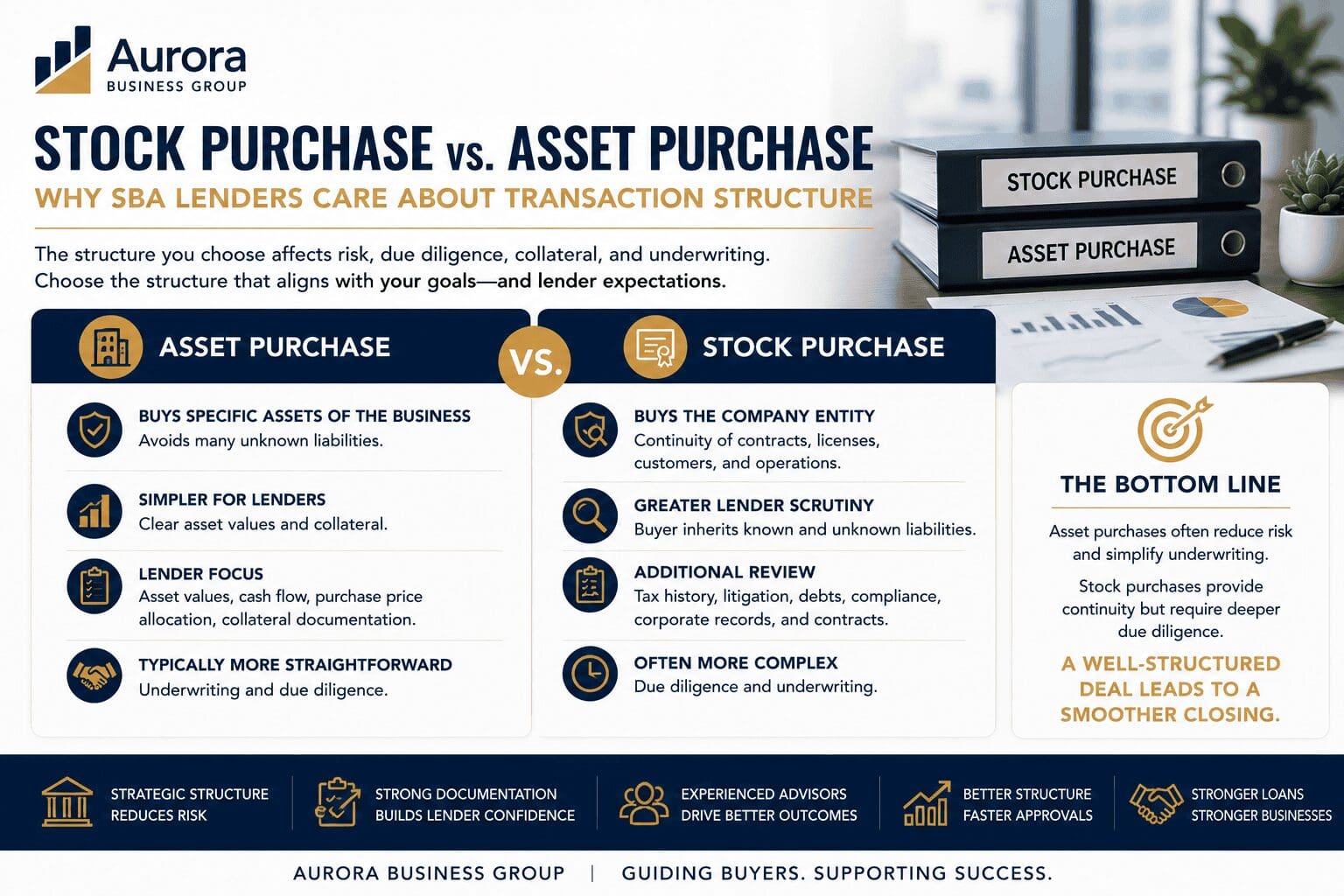
When financing a business acquisition through an SBA loan, lenders carefully evaluate whether the deal is structured as an Asset Purchase or a Stock Purchase because each presents different levels of risk.
Asset Purchase
In an asset purchase, the buyer acquires selected assets of the business, such as:
✔ Equipment
✔ Inventory
✔ Customer relationships
✔ Intellectual property
✔ Goodwill
From a lender’s perspective, asset purchases are often simpler because buyers can generally avoid many unknown liabilities, including potential tax issues, lawsuits, or contractual obligations from prior ownership.
Lenders typically focus on:
- Asset values
• Cash flow performance
• Purchase price allocation
• Collateral documentation
Because the acquired assets become collateral for the SBA loan, underwriting is often more straightforward.
Stock Purchase
In a stock purchase, the buyer acquires ownership of the existing company itself.
The advantage is continuity:
✔ Existing contracts remain in place
✔ Customer relationships continue uninterrupted
✔ Business operations transition more smoothly
However, lenders often apply greater scrutiny because buyers may inherit both known and unknown liabilities.
Additional lender review may include:
- Tax compliance history
• Existing debt obligations
• Litigation exposure
• Regulatory compliance
• Corporate records and contracts
As a result, stock purchases frequently require more extensive due diligence.
Why This Matters for SBA Financing
Lenders are evaluating three primary factors:
1️⃣ The Business
2️⃣ The Buyer
3️⃣ The Transaction Structure
A well-structured transaction can accelerate underwriting, simplify collateral analysis, and improve approval timelines.
A poorly structured transaction can create unnecessary delays, increased costs, and additional lender requirements.
The Bottom Line
Asset purchases often provide greater protection from legacy liabilities and are generally easier for lenders to underwrite.
Stock purchases may preserve important contracts, licenses, and operating continuity but typically require deeper due diligence.
Before pursuing financing, buyers should work closely with their lender, attorney, accountant, and transaction advisor to determine which structure best aligns with their acquisition strategy.
At Aurora Business Group, we help buyers evaluate transaction structures, prepare lender-ready financing packages, and navigate the SBA approval process from LOI to closing.
Structure matters. Due diligence matters. Financing strategy matters.
Have you acquired a business through a stock purchase or an asset purchase? What lessons did you learn from the process?
#SBALoan #BusinessAcquisition #MergersAndAcquisitions #ETA #SearchFund #BusinessBroker #SmallBusinessOwnership #BusinessFinance #AuroraBusinessGroup #EntrepreneurshipThroughAcquisition
Structure matters. Due diligence matters. Financing strategy matters.