
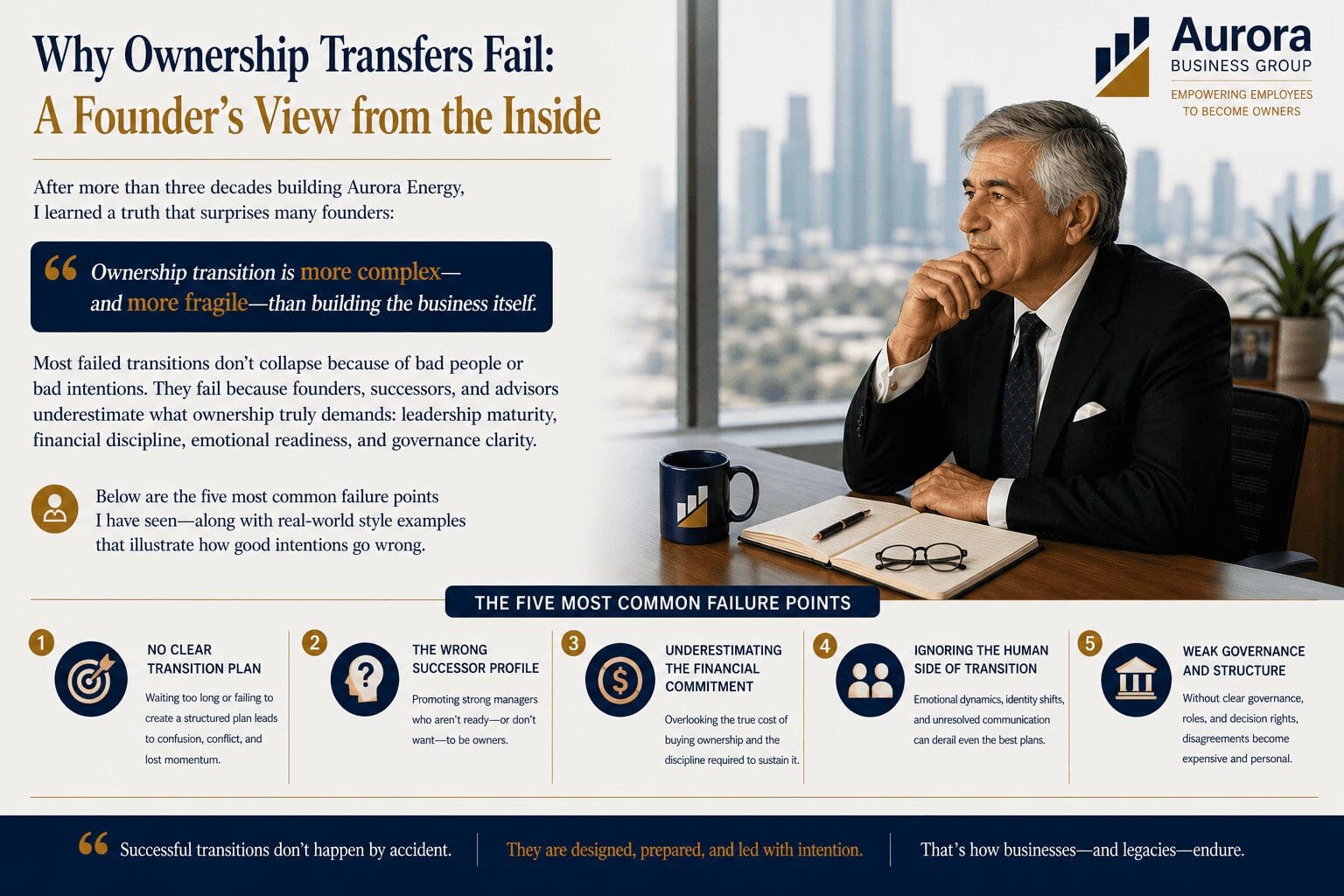
After more than three decades building Aurora Energy, I learned a truth that surprises many founders:
Ownership transition is more complex—and more fragile—than building the business itself.
Most failed transitions don’t collapse because of bad people or bad intentions. They fail because founders, successors, and advisors underestimate what ownership truly demands: leadership maturity, financial discipline, emotional readiness, and governance clarity.
Below are the five most common failure points I have seen—along with real-world style examples that illustrate how good intentions go wrong.
- Equity Is Transferred Before Leadership Maturity Is Proven
- Financial Structures That Strain the Business They’re Meant to Preserve
- Founders Underestimate the Emotional Shift from Control to Influence
- Governance Is Vague, Informal, or Assumed
- The Transition Is Rushed Instead of Phased
The Predictable Outcome When These Issues Are Ignored
Across industries and company sizes, the results repeat:
- Founders experience regret and loss of purpose
- New owners feel resentment or inadequacy
- Businesses lose momentum, culture, or financial strength
None of this is caused by bad intentions.
It happens because ownership transitions are rarely designed—they are improvised.
Why I Share This
Preparing Aurora Energy for its next chapter forced me to confront these realities honestly. It required slowing down, redesigning assumptions, and treating ownership transfer as a multi-year leadership journey—not a closing date.
That experience reshaped how I think about succession, governance, and legacy.
A well-designed ownership transition does more than preserve a business.
It protects people, culture, and the future—while allowing founders to step forward into influence instead of disappearing into absence.
A Question for Founders and Future Owners
If you’ve been through an ownership transition—
what challenged you more: letting go, or stepping up?